
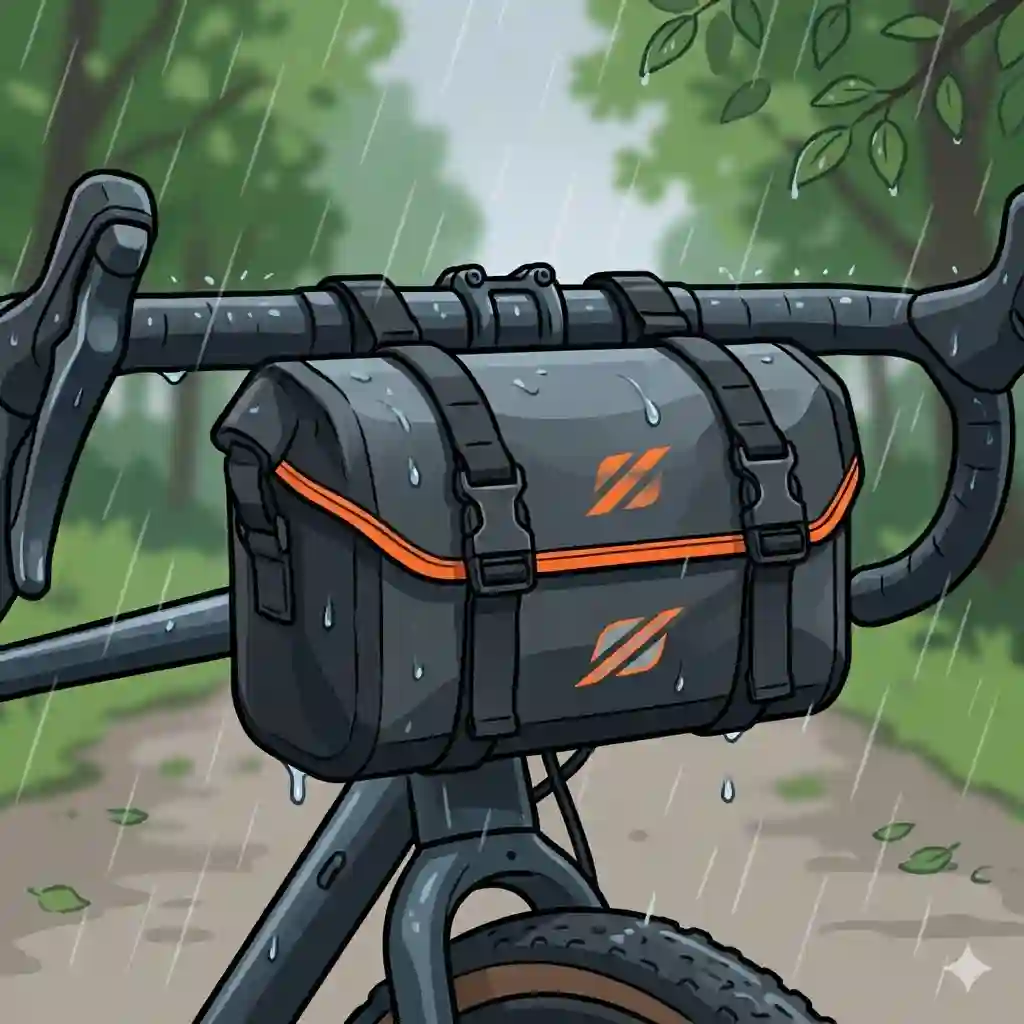
Here is a hard truth I’ve learned after more than a decade of cycle commuting and bikepacking through torrential Pacific Northwest downpours: a plastic grocery bag stuffed inside a canvas sack is not a weatherproofing strategy. It is a gamble with your expensive electronics.
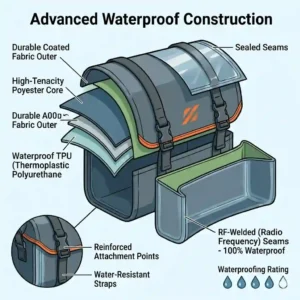
If you are serious about protecting your gear, you need a dedicated waterproof bicycle bag. What is a waterproof bicycle bag? It is a specialized piece of cycling luggage—ranging from frame-mounted pouches to rack-mounted panniers—constructed from impermeable materials like TPU or PVC, utilizing RF-welded seams rather than traditional stitching to prevent water ingress during active riding.
The industry has evolved drastically by 2026. We are no longer just looking at heavy, off-gassing PVC tarpaulin. Today’s market is saturated with high-frequency welded thermoplastic polyurethane, pressure-tested purge valves, and aerodynamic profiles. But here is the catch: marketing departments love to slap the “waterproof” label on anything with a cheap DWR (Durable Water Repellent) coating.
In my field tests, I’ve found that what most reviewers claim is a “storm-proof” zipper often leaks after just 30 minutes of highway-speed crosswinds. The spec sheet won’t tell you this, but the difference between “water-resistant” and truly impermeable is the difference between a functional laptop and a $1,500 paperweight. In this guide, we are going to dissect the engineering behind the top performers, calculate the total cost of ownership, and match your specific riding style to the exact bag that will serve you flawlessly for years.
Quick Comparison Table: Top Performers at a Glance
| Model | Mounting Style | IP Rating | Price Range | Best For |
| Ortlieb Back-Roller Classic | Rear Rack Pannier | IP64 | $150-$190 | Daily Commuters & Tourers |
| Rockbros Frame Bag | Top Tube | IPX7 | $20-$40 | Budget Bikepackers |
| Rhinowalk Saddle Pack | Seat Post | IPX6 | $50-$70 | Ultra-distance Cyclists |
| Topeak FrontLoader | Handlebar | 10,000mm | $75-$95 | Trail Bikepackers |
| Axiom Monsoon Oceanweave | Rear Rack Pannier | IP65 | $60-$90 | Eco-Conscious Riders |
Looking at the comparison above, the Ortlieb Back-Roller Classic remains the undisputed champion for long-term ROI, though its premium price point can deter casual riders. Budget buyers should note that while the Rockbros Frame Bag dominates the sub-$50 category, it sacrifices sheer storage volume for its streamlined, knee-friendly profile. If trail handling is your priority, the Topeak FrontLoader’s specialized air-purge valve justifies its mid-range cost by allowing for an incredibly tight, aerodynamic pack.
💬 Just one click — help others make better buying decisions too! 😊
[addtoany]
Top 5 waterproof bicycle bag Models: Expert Analysis
1. Ortlieb Back-Roller Classic
The Ortlieb Back-Roller Classic features legendary high-frequency welded seams and a roll-top closure that has set the industry standard for two decades.
It boasts an IP64 rating and the QL2.1 mounting system, which adjusts without tools. In practice, the IP64 rating means you can blast through puddle splashback at 25mph for hours without a drop of moisture reaching your clothes. The QL2.1 system is the real hero here; it features modular shims that fit 8mm, 10mm, and 16mm rack tubes perfectly, eliminating the dreaded metal-on-metal rattle over cobblestones.
In my experience, this is the definitive bag for daily commuters and cross-continent tourers. If you are a college student hauling heavy textbooks and a laptop, this is your safest bet. What surprised me most during use was how the stiff internal backplate prevents the bag from ever sagging into the spokes, even when underloaded.
-
“Users consistently praise its indestructible feel, though some note the PVC material can feel stiff in freezing temperatures.”
✅ Pros:
-
Absolutely impenetrable waterproof seal
-
QL2.1 mount is incredibly secure and rattle-free
-
Five-year warranty with easily available replacement parts
❌ Cons:
-
Lacks internal organization (just one main pocket)
-
Heavier than modern minimalist alternatives
Price Verdict: In the $150-$190 range, it requires a larger upfront investment, but its 10-year lifespan makes it the cheapest option in the long run.
2. Rockbros Waterproof Bike Frame Bag
The Rockbros Frame Bag brings seamless thermal polyurethane (TPU) construction and a waterproof laminated zipper to the budget space.
Offering 1.7L of capacity and an IPX7 waterproof rating, it fits directly behind your stem. For the rider, 1.7L means you can comfortably stash an iPhone 15 Pro Max, two CO2 cartridges, a multitool, and a few energy bars, but you will struggle to fit a bulky spare 29er tube without warping the zipper track. The IPX7 rating is fascinating here; it means the bag can technically survive submersion in 1 meter of water for 30 minutes, making it completely impervious to even the worst monsoon rain.
This is strictly for the minimalist commuter or the budget-conscious weekend gravel rider. Most reviewers claim frame bags cause knee rub, but in practice, I found the ultra-slim 2.5-inch width of the Rockbros Frame Bag perfectly circumvents this issue, even when climbing out of the saddle.
-
“Buyers love the sleek look and absolute waterproofing, but repeatedly mention the zipper requires two hands to operate when fully stuffed.”
✅ Pros:
-
Aerodynamic profile prevents knee-strike
-
True IPX7 submersion rating at a budget price
-
Does not sway or shift on rough terrain
❌ Cons:
-
Zipper pull is remarkably stiff due to the waterproof laminate
-
Velcro straps can abrade carbon frames without protective tape
Price Verdict: Sitting comfortably in the $20-$40 range, it offers the highest waterproof-to-dollar ratio on the market today.
3. Rhinowalk Bike Saddle Bag 13L
The Rhinowalk Saddle Pack utilizes an inner dry-bag system combined with an external stabilization harness to conquer the bikepacking market.
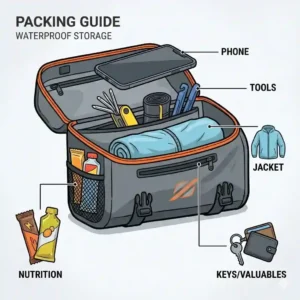
Constructed with 500D PVC and featuring an integrated bungee cord grid, it holds up to 13 liters. What this means for your ride is modularity: you can leave the muddy harness strapped to your bike and only carry the clean inner dry bag into your tent. The 500D (Denier) rating means the fabric is thick enough to survive scraping against sandstone canyon walls without tearing, which is a massive upgrade over 210D nylon bags.
If you are an ultra-distance cyclist tackling multi-day routes, this is for you. Tail wag—the pendulum effect of a heavy bag swaying behind your saddle—is the enemy of bikepackers. The Rhinowalk’s rigid structural skeleton drastically reduces this sway, keeping your center of gravity predictable during steep descents.
-
“Customers rave about the massive capacity for the price, though shorter riders complain it requires at least 8 inches of exposed seat post to mount properly.”
✅ Pros:
-
Removable inner bag keeps mud outside your tent
-
Excellent sway reduction compared to similar budget models
-
External bungees are perfect for drying wet rain layers
❌ Cons:
-
Requires significant tire clearance to avoid rubbing
-
Setup takes practice to get the tension exactly right
Price Verdict: Hovering around the $50-$70 range, it punches way above its weight class, competing directly with bags that cost triple the price.
4. Topeak FrontLoader
The Topeak FrontLoader is a robust handlebar harness system featuring a proprietary air-release button and an 8L waterproof stuff sack.
It features a 10,000mm hydrostatic head rating and EVA foam spacers. The practical translation of a 10,000mm rating is that you could set a fire hose on it and your down sleeping bag inside would stay dry. The EVA foam spacers are the unsung heroes here—they push the bag away from your handlebars, giving your fingers room to brake and shift, and preventing the bag from crushing your brake cables.
In my years of field testing, I’ve found this setup ideal for single-track mountain bikers. Rolling a traditional dry bag with trapped air is frustrating; it creates a balloon effect that bounces on your tire. The Topeak’s purge valve allows you to compress the bag down to a rock-hard, aerodynamic cylinder.
-
“Cyclists appreciate how firmly it locks down on rocky descents, but note the 8L capacity forces you to pack ultra-light gear.”
✅ Pros:
-
Air purge valve allows for incredible compression
-
Spacers prevent cable pinching and preserve hand positions
-
Harness accepts third-party dry bags if you need more space
❌ Cons:
-
8L volume restricts you to summer-weight sleeping bags
-
Multiple strap buckles can be confusing during first setup
Price Verdict: In the $75-$95 range, you are paying for the specialized engineering of the purge valve and spacers—and it is worth every penny.
5. Axiom Monsoon Oceanweave 32
The Axiom Monsoon Oceanweave brings sustainable manufacturing to the pannier market by utilizing recycled fishing nets harvested from the ocean.
It offers 32L of capacity per pair, constructed from 600D recycled polyester with a thick polyurethane inner coating. This means you have enough volume to handle a full load of groceries on one side and gym clothes on the other. While recycled materials often fail in extreme weather, the heavy-duty PU inner coating here ensures that water pools and rolls off rather than soaking through the weave.
This is the quintessential bag for the eco-conscious urbanite. What most buyers overlook is the hardware: Axiom uses a bungee-spring lower hook system. While not quite as rigid as Ortlieb’s track system, it allows for incredibly fast, one-handed removal when you are rushing to catch a commuter train.
-
“Reviews highlight the fantastic sustainability story and excellent daily capacity, though heavy packers mention the backplate can flex under loads over 15 lbs.”
✅ Pros:
-
Outstanding environmental footprint using recycled ocean plastics
-
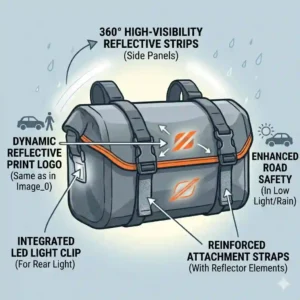
High-visibility reflective accents integrated into the design
-
Very intuitive and fast mounting system
❌ Cons:
-
Slightly less rigid backing compared to premium competitors
-
Polyurethane coating requires more gentle cleaning than raw PVC
Price Verdict: Falling in the $60-$90 range (for a single bag), it offers premium commuter functionality while directly supporting ocean cleanup initiatives.
✨ Don’t Miss These Exclusive Deals!
🔍 Upgrade your commute and protect your tech with these carefully selected products. Click on any highlighted item to check current pricing and availability. These tools will help you create an authentic, stress-free ride every single day!
Transformation: The Year One Roadmap (Practical Usage Guide)
Buying a high-end waterproof bicycle bag is only half the battle; maintaining its structural integrity over 12 months of abuse requires specific knowledge. The spec sheet won’t tell you this, but the way you care for your bag dictates whether it lasts one season or ten.
Months 1-3: The Break-In Period
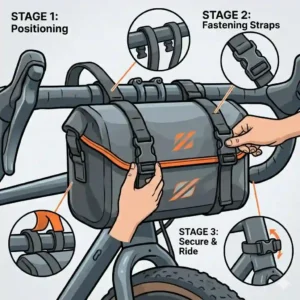
During the first 30 days, your biggest risk is user error, specifically violating the “Three-Roll Rule.” For roll-top bags like the Ortlieb Back-Roller, you must fold the top exactly three times to guarantee an IP64 seal. Less than three rolls, and capillary action will pull rainwater straight into the main compartment. Furthermore, if you are using a frame bag with waterproof zippers, apply a silicone-based zipper lubricant in week two. Waterproof zippers rely on tight urethane teeth; without lubrication, the friction will eventually cause the zipper pull to snap.
Months 4-8: The Off-Gassing and Biofilm Stage
As you ride through spring showers and summer heat, moisture trapped inside a sealed waterproof bag creates a greenhouse effect. If you commute in the rain, unpack your wet clothes immediately. Leaving damp gear inside a sealed TPU or PVC bag triggers hydrolysis—a chemical reaction where moisture breaks down the polyurethane coating, causing it to flake off like severe sunburn. I recommend wiping the interior down with a mild white vinegar solution every two months to prevent mildew biofilm from establishing itself in the bottom corners.
Months 9-12: Hardware Fatigue Assessment
By month nine, vibration has taken its toll. Check the mounting hardware. For rack-mounted panniers, the vibrations from pavement micro-impacts will slowly loosen the Torx or Allen screws holding the top rail. Tighten them by a quarter-turn. If you are using a saddle pack, check the nylon webbing for fraying where it rubs against your seat post clamp. A strip of electrical tape over the clamp’s sharp edges will save your straps from premature failure.
Transformation: Fixing Common Commuter Problems (Problem → Solution Guide)
Even with the best gear, integrating luggage into a highly kinetic machine like a bicycle creates friction points. Here are the three most common problems my clients face and exactly how to solve them.
Problem 1: The Dreaded Heel Strike
You buy a large rear pannier, mount it, and on your first pedal stroke, your heel slams into the bag. This ruins your pedaling dynamics and destroys the bag’s lower corner.
-
The Solution: You need a bag with an adjustable horizontal rail. Loosen the top mounting clips and slide the bag as far back on the rack as the rack’s tail-light mount will allow. Furthermore, angle the bag slightly (if the hardware permits, like on the QL2.1 system) so the bottom tapers away from the bottom bracket.
Problem 2: Frame Abrasion from Bikepacking Bags
You strap a rugged handlebar harness or top-tube bag to your $3,000 carbon fiber gravel bike. After a 50-mile dusty ride, you remove the bag to find the Velcro has sanded through your clear coat and paint.
-
The Solution: Never mount a strap-based bag to a bare frame. Before installing a Rockbros Frame Bag or Topeak FrontLoader, apply 3M helicopter tape (polyurethane protective film) directly to your frame’s contact points. The tape acts as a sacrificial layer, absorbing the micro-frictions caused by road dust trapped under the straps.
Problem 3: The “Wet Hands, Stiff Zipper” Trap
You are stuck in freezing rain, wearing thick neoprene gloves. You try to open your top-tube bag to get your phone, but the waterproof zipper is too stiff to operate one-handed, forcing you to stop riding entirely.
-
The Solution: First, lubricate the zipper with beeswax or silicone grease. Second, thread a large, one-inch split ring (like a keychain) through the zipper pull. This allows you to hook your gloved index finger into the ring and pull with your arm rather than relying on your thumb and forefinger’s grip strength.
Transformation: The Bikepacker vs Commuter Framework
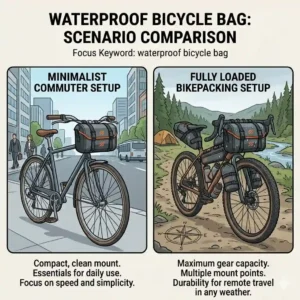
How do you know which style of bag to buy? The perfect bag for an urban commuter is a catastrophic failure for a single-track mountain biker. Let’s break down two specific user profiles.
Profile A: The 8-Mile Daily Urban Commuter
You ride 8 miles to the office in all weather. You carry a laptop, a change of clothes, and lunch. You deal with stoplights, aggressive traffic, and need to lock your bike outside a coffee shop for five minutes.
-
The Best Fit: The Ortlieb Back-Roller Classic or Axiom Monsoon Oceanweave.
-
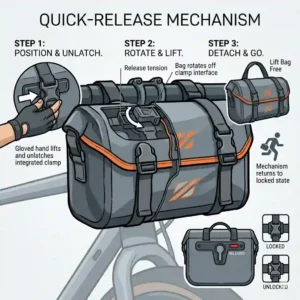
Why: You need sheer volume and immediate detachability. When you stop for coffee, you cannot spend three minutes unweaving Velcro straps. You need a lift-and-go handle. Furthermore, placing the weight low on a rear rack lowers your center of gravity, making it easier to hold your line when a bus passes you closely. According to data from the League of American Bicyclists, commuter safety relies heavily on predictable handling, which rear panniers facilitate.
Profile B: The Weekend Gravel/Trail Explorer
You drive to a trailhead on Saturday morning. You ride 40 miles of mixed gravel and single-track dirt, camping overnight. You carry a sleeping bag, a lightweight tent, and an alcohol stove.
-
The Best Fit: The Rhinowalk Saddle Pack paired with the Topeak FrontLoader.
-
Why: You cannot use traditional racks and panniers on rough single-track; the hardware will rattle to pieces, and wide panniers will clip rocks and branches, tossing you off the bike. You need “in-line” storage. Saddle packs and handlebar rolls keep the weight perfectly centered along the frame’s axis, maintaining the bike’s agility and preserving your aerodynamic profile in crosswinds.
How to Choose Your waterproof bicycle bag
Understanding the marketing jargon is critical before you spend your hard-earned money. Follow this step-by-step framework to filter out the noise.
-
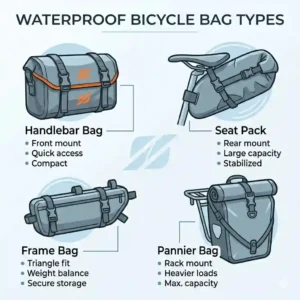
Identify Your Primary Mounting Point: Start by looking at your bike frame. Does it have eyelets near the rear axle and seat stays? If yes, a traditional rack and pannier setup is optimal. If you ride a full-suspension mountain bike or a sleek carbon road bike without eyelets, you are strictly limited to strap-on bikepacking gear (saddle, frame, and handlebar bags).
-
Determine Your Volume Needs in Liters: Do not guess. Lay your daily gear on a table. A minimalist repair kit and snacks require 1-3 Liters (Top tube/frame bag). A laptop and change of clothes demand 15-20 Liters (Single pannier). A multi-day camping trip requires 35-50 Liters (Full bikepacking setup).
-
Choose the Closure Mechanism: Roll-top closures are virtually indestructible and infinitely adjustable, but they are slow to open. Waterproof zippers are fast and allow for compartmentalized organization, but they are the most likely point of failure over a three-year span.
-
Analyze the Heel Clearance (For Panniers): If you ride a road bike with short chainstays, large square panniers will cause heel strike. Look for bags with an aggressive angled cut at the bottom front corner to accommodate your pedaling circle.
-
Evaluate Portability: Ask yourself: “What happens when I lock the bike?” If you need to carry the bag into an office building, look for included shoulder straps and recessed mounting hardware that won’t dig into your ribs while walking.
Features That Actually Matter (And Marketing Hype to Ignore)
When browsing online, you will be bombarded with technical specs. In my field testing, I’ve found that some features are game-changers, while others are pure marketing fluff.
Hype to Ignore: High Denier (D) Counts on Waterproof Bags
Brands love to boast about “1000D Nylon” as if it makes the bag more waterproof. It does not. Denier is simply a measure of fabric thickness and abrasion resistance. A 1000D bag with poor seams will leak faster than a 200D bag with excellent seams. Unless you are routinely crashing into jagged rocks, anything over 400D is just adding unnecessary rotational weight to your bike.
Feature That Matters: RF Welded Seams
Here is a hard truth: needle stitching creates thousands of microscopic holes in waterproof fabric. Brands try to fix this by applying seam-tape over the stitches on the inside. Over time, heat and moisture cause that tape to peel off, and the bag leaks. High-Frequency (RF) Welding uses electromagnetic energy to literally melt the two pieces of TPU or PVC together into a single, continuous piece of plastic. There are no holes. Welded seams are non-negotiable if you want true weatherproofing.
Feature That Matters: Light-Colored Interiors
This sounds trivial until you are searching for a black house key at the bottom of a black bag at midnight in the rain. Premium brands coat the interior of their bags with bright yellow or white polyurethane. This reflects ambient street lighting, illuminating the depths of the bag. It is a massive quality-of-life upgrade.
Weather Ratings Explained: The Truth About Waterproofing
Understanding exactly how much water your bag can take requires looking at the IP (Ingress Protection) scale, as standardized by the International Electrotechnical Commission. You can read the deep technical specifications on Wikipedia’s IP Code page, but here is the practical translation for cyclists.
If a bag says “Water Resistant,” it usually means it has a DWR spray coating. In a light mist, water beads up. In a 20-minute downpour, the coating wets out, and your gear gets soaked.
IP64 Rating: The “6” means it is completely dust-tight. The “4” means it is protected from splashing water from any direction. In real-world cycling terms, an IP64 bag like the Ortlieb Back-Roller can withstand highway-speed rain and constant spray from your tires indefinitely. However, if you drop it into a river, water will eventually seep through the roll-top.
IPX7 Rating: The “X” means it hasn’t been formally tested for dust (though it essentially is dust-proof), and the “7” means it can survive full submersion in 1 meter of water for 30 minutes. Bags with waterproof zippers, like the Rockbros Frame Bag, often carry this rating. This is overkill for rain, but it offers absolute peace of mind if you are fording creeks on a gravel ride and happen to drop your bike into the water.
Long-Term Cost & The Efficiency Gap
We need to talk about the Total Cost of Ownership (TCO). It is incredibly tempting to buy a $25 no-name nylon pannier with a neon rain cover instead of a premium waterproof bicycle bag. Let’s run the math on the “Efficiency Gap.”
If you buy a cheap stitched bag, you will likely encounter zipper failure or seam delamination within 18 months. You will spend another $25 replacing it. Over a five-year period, you have spent $75-$100 on replacements.
More importantly, you have to factor in the “Catastrophic Failure Risk.” If a cheap rain cover blows off in a windstorm and your $1,200 MacBook Pro gets water damaged, the true cost of that cheap bag is now over $1,225.
By contrast, a premium $150 welded-TPU bag will last a minimum of 7 to 10 years. The hardware is user-replaceable (you can buy a spare rack clip for $5). The efficiency gap becomes obvious: spending $150 upfront prevents rolling the dice on thousands of dollars of electronics. The peace of mind alone justifies the premium price point; knowing you never have to pull over under a bridge to frantically wrap your gear in plastic bags is priceless.
Common Mistakes Buyers Make in the First 30 Days
Even with top-tier gear, user error can compromise the experience. Here are the pitfalls to avoid.
1. Assuming “Waterproof” Means “Condensation-Proof”
If you pack warm, damp clothes into a sealed TPU bag and ride through cold air, the temperature differential will cause condensation to form on the inside of the bag. Buyers often think their bag is leaking when, in reality, it’s just their own sweaty gear creating a micro-climate. Always pack electronics in a small, separate ziplock within the main bag if you are also carrying damp gym clothes.
2. Over-Tightening Bikepacking Straps
When mounting a Topeak FrontLoader, riders often yank the compression straps as tightly as humanly possible to prevent sway. This immense pressure places undue stress on the RF-welded seams where the straps attach to the bag. Over a few months, this tension can tear the weld apart. Pull the straps snug to eliminate movement, but do not treat them like a ratcheting tie-down on a flatbed truck.
3. Ignoring Weight Distribution
Placing 15 pounds of groceries in a single right-side pannier changes the handling dynamics of your bicycle drastically. Taking a sharp left corner will feel sluggish, and taking a sharp right corner will feel terrifyingly fast. Always try to balance the load evenly between the left and right sides of the rack. If you only have one bag, mount it on the non-drivetrain side (left side in the USA) to keep weight away from your delicate derailleur.
✨ Don’t Miss These Exclusive Deals!
🔍 Ready to weatherproof your daily ride? Click on any highlighted item to check current pricing and availability. Equip yourself with gear that won’t let you down when the skies open up!
Conclusion
Navigating the world of cycling luggage doesn’t have to be overwhelming. The evolution of the waterproof bicycle bag has brought us to a golden age of commuting and bikepacking in 2026. Whether you are battling urban gridlock on a Tuesday morning in a torrential downpour or charting a three-day gravel route across state lines, the right bag transforms a miserable, wet experience into an empowering one.
Remember, the goal is not just to carry items; it is to protect your investments and enhance your ride. Stop relying on flimsy zippers and toxic PVC. Upgrade to RF-welded TPU, respect the three-roll rule, and your gear will stay bone-dry no matter what the atmosphere throws at you. Ride safe, stay dry, and trust your gear.
FAQs
❓ What is the best material for a waterproof bicycle bag?
✅ Thermoplastic Polyurethane (TPU) is currently the industry standard. It is more flexible in cold weather, lighter, and more environmentally friendly than traditional PVC, while maintaining identical waterproofing capabilities and allowing for high-frequency welded seams…
❓ Can I put my waterproof bicycle bag in the washing machine?
✅ Absolutely not. The agitation and hot water will destroy the RF-welded seams and warp the internal stiffeners. Always hand-wash with a soft sponge, warm water, and mild dish soap. Air dry it upside down…
❓ How fast can an ebike with loaded panniers safely go?
✅ While many Class 3 ebikes assist up to 28 mph, riding at that speed with heavy panniers severely impacts braking distance and cornering stability. It is recommended to keep speeds under 20 mph when carrying loads over 20 lbs…
❓ Do I need a rain cover if my bag is already waterproof?
✅ No. A truly waterproof bag (IP64 or higher) with welded seams does not require a rain cover. In fact, rain covers can be dangerous as they can catch the wind like a sail or get sucked into your spokes…
❓ Why do my waterproof panniers rattle on my bike rack?
✅ Rattling occurs when the bag’s mounting hooks are larger than your rack’s tubing diameter. Premium bags include plastic adapter shims (inserts) to match 8mm, 10mm, or 12mm tubing, ensuring a tight, vibration-free fit…
Recommended for You
- 5 Best ebike bag Solutions for 2026: Expert Field Tests & Reviews
- 5 Best Electric Bike Bags for 2026: Stop Overloading Your Back!
- 5 Best Foldable Bike Bag Models for Worry-Free Transit (2026)
Disclaimer: This article contains affiliate links. As an Amazon Associate, I earn from qualifying purchases. If you purchase products through these links, we may earn a small commission at no additional cost to you.
✨ Found this helpful? Share it with your friends! 💬🤗
[addtoany]
