
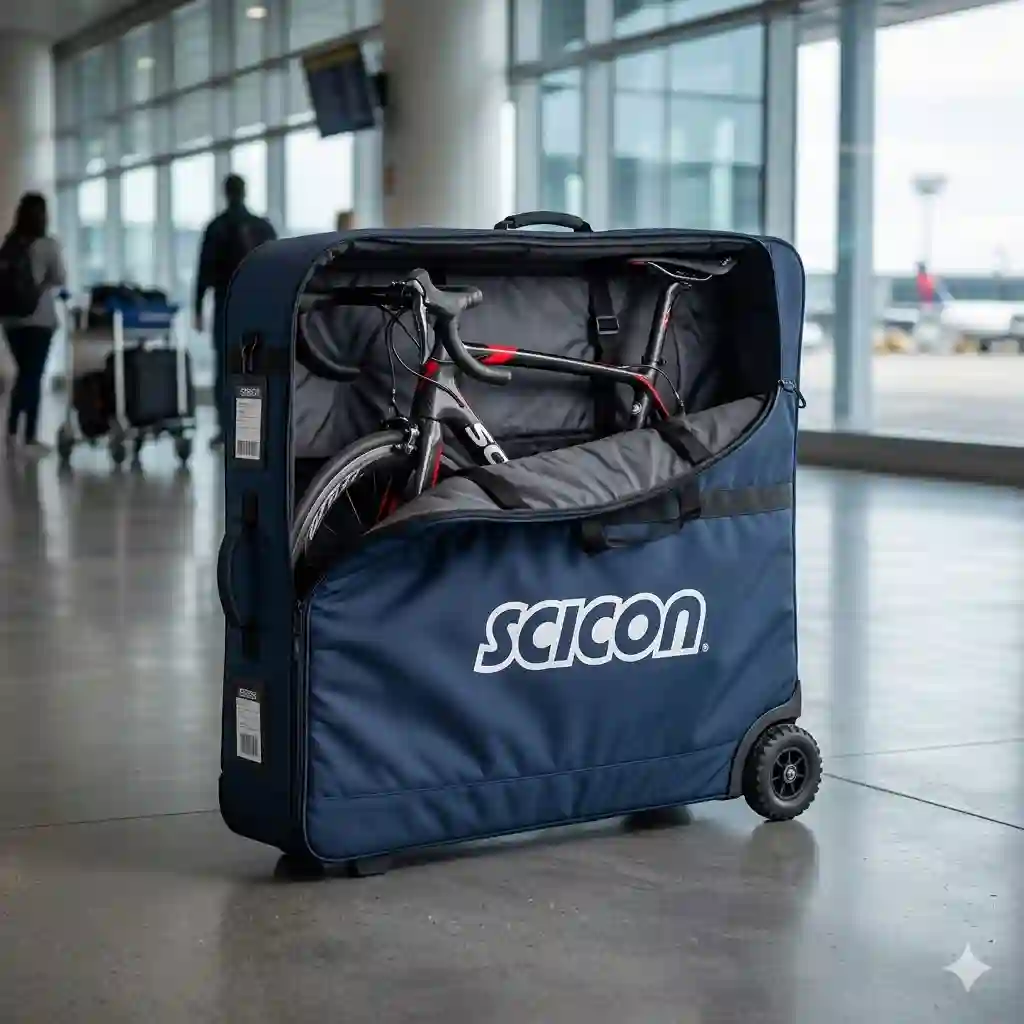
If you have ever stood at an oversized baggage carousel watching a mountain of luggage tumble onto the belt, you know the pure, unadulterated anxiety of flying with a bicycle. What is a scicon bike case? Simply put, it is a specialized piece of travel luggage engineered by the Italian brand Scicon (and its competitors in the space) to transport bicycles on airplanes safely, combining impact protection with internal mounting systems to prevent frame damage.
Over my 10+ years as a cycling consultant and former team mechanic, I have packed, shipped, and flown with hundreds of bicycles. I’ve seen $12,000 carbon superbikes reduced to splintered tragedy because someone trusted a cardboard box and some bubble wrap. A high-quality scicon bike case isn’t just luggage; it’s an insurance policy for your peace of mind.
In my field tests across dozens of international flights, what surprised me most wasn’t how bags handled the air, but how they handled the ground. Getting through TSA, dragging the bag across cobblestones in Belgium, and squeezing it into European rental cars are the true tests. The spec sheets won’t tell you this, but the caster wheels on your bag are often more important than the exterior shell material. In this comprehensive guide, we will dive deep into the top cases available in 2026, comparing their real-world durability, packing efficiency, and total cost of ownership so you can make an informed decision.
📊 Quick Comparison: Top Travel Cases at a Glance
| Brand & Model | Case Type | Handlebar Removal? | Est. Price Range | Expert “Best For” Verdict |
| Scicon Aerocomfort 3.0 Road | Soft w/ Internal Frame | No | $800 – $1,050 | Road cyclists wanting 5-minute packing |
| Scicon Aerotech Evolution X | Hard ABS Plastic | Yes | $1,200 – $1,400 | Maximum protection on chaotic long-hauls |
| Scicon Aerocomfort Tri 3.0 | Soft w/ Internal Frame | No (Keeps Aero Bars) | $850 – $1,100 | Triathletes maintaining precise fits |
| Evoc Bike Travel Bag Pro | Hybrid / Soft | Yes | $650 – $800 | Off-road riders needing rough-terrain wheels |
| Thule RoundTrip Transition | Hard Case w/ Workstand | Yes | $800 – $1,000 | Destination assembly & remote mechanics |
Looking at the comparison above, the soft-shell Aerocomfort models deliver the absolute best value for riders who dread mechanical teardowns, saving you up to 30 minutes of reassembly time at your destination. However, if sheer impact protection is your priority, the Aerotech Evolution X’s hard shell justifies its premium price tag. Budget-conscious buyers or those hitting gravel and MTB trails should note that the Evoc hybrid sacrifices the “no-removal” handlebar luxury for a significantly lower price point and superior rolling chassis.
💬 Just one click — help others make better buying decisions too! 😊
[addtoany]
🏆 Top 5 Cases: Expert Analysis & Real-World Testing
Here is my deep dive into the absolute best options on the market, combining spec analysis with years of tarmac-level testing.
1. Scicon Aerocomfort 3.0 TSA Road Bike Travel Bag: The Frequent Flyer’s Best Friend
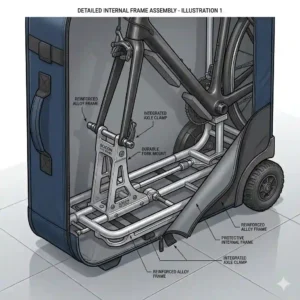
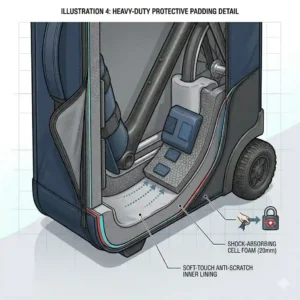
This is the flagship soft case that revolutionized how we pack. The standout feature is the internal metal frame base (the “Antishock Bike Frame”).
Let’s interpret the specs: it weighs just 17.6 lbs (8kg) empty and utilizes a heavy-duty nylon exterior. In practice, this 17.6-pound tare weight means you can pack a 16-pound road bike, a helmet, shoes, and tools, and still easily stay under the standard 50-pound (23kg) airline weight limit, completely avoiding oversized weight fees. You literally do not have to remove your handlebars or seatpost; you only take off the wheels.
In my experience, this scicon bike case is perfect for the dedicated roadie who travels 3-5 times a year. What most buyers overlook is the convenience at the destination hotel. You pull the bike out, pop the wheels on, and you are rolling to the coffee shop in five minutes. However, the anti-recommendation here is real: if you are flying on tiny regional jets where baggage is stacked violently rather than stored upright, the lack of a hard top shell leaves your shifters somewhat vulnerable.
Customer Feedback Summary: Most riders praise the incredibly fast packing time, though a few note that you must be diligent about using the included padding around the rear derailleur to prevent bending.
✅ Pros:
-
Zero handlebar or seatpost removal required.
-
Exceptionally lightweight to avoid baggage fees.
-
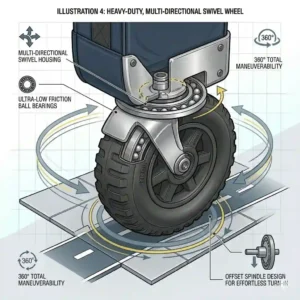
High-quality multi-directional 360° twin caster wheels.
❌ Cons:
-
Soft sides offer less crush protection than ABS plastic.
-
Derailleur requires careful padding.
Price Verdict: In the $800 to $1,050 range, you are paying for time saved; it is a phenomenal value for roadies who hate wrenching.
2. Scicon Aerotech Evolution X TSA Bike Case: The Carbon Armor
When maximum protection is non-negotiable, you step up to a hard shell. The Aerotech’s defining feature is its proprietary ABS composite plastic shell.
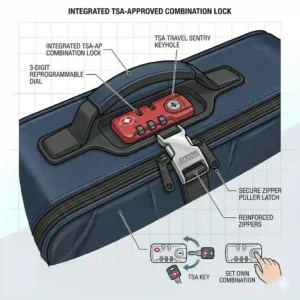
The spec sheet boasts “patented TSA-approved D-Netic locks” and a total volume capable of swallowing large frames with integrated seat masts. What this translates to for you is absolute security. ABS plastic, combined with the internal padding, means the case absorbs the blunt force of a dropped suitcase so your carbon fiber frame doesn’t have to. You do have to remove the pedals, handlebars, and wheels, which requires basic mechanical competence.
I recommend this case specifically for international travelers heading to multi-week training camps or grand fondos. If your bike costs over $8,000, this is the scicon bike case you want. The spec sheet won’t tell you this, but the asymmetrical geometry of the case actually allows it to fit surprisingly well in the back of standard European hatchbacks—a godsend when renting cars in Italy or France.
Customer Feedback Summary: Reviewers universally laud its indestructible nature but frequently mention that packing the first time is a puzzle that requires a learning curve.
✅ Pros:
-
Supreme crush and impact resistance.
-
TSA-approved locks integrated beautifully into the shell.
-
Fits large frames (up to 62cm) comfortably.
❌ Cons:
-
Heavy (around 26 lbs empty).
-
Requires handlebar and pedal removal.
Price Verdict: Sitting in the $1,200 to $1,400 range, it’s a hefty investment that pays for itself the first time a baggage handler drops it off a conveyor belt.
3. Scicon Aerocomfort 3.0 TSA Triathlon Bike Travel Bag: The Fit-Preserver
Triathlon bikes are notoriously difficult to pack due to complex integrated cockpits and aero bars. This case solves that exact problem.
It features a specialized widened front section and an elongated internal frame. In the real world, this means you do not have to touch your meticulously dialed-in aero bar extensions or your hidden brake cable routing. Disassembling an integrated tri-cockpit can take an hour and requires a torque wrench; this bag eliminates that entirely. It is essentially the road version, widened and reinforced for TT geometries.
If you are an Ironman competitor, this is your holy grail. I’ve watched athletes crying in hotel lobbies because they stripped a bolt trying to reassemble their aero bars the night before a race. This case prevents that nightmare. However, because it is wider at the front, it can be slightly more awkward to navigate through narrow airport security stanchions.
Customer Feedback Summary: Triathletes love preserving their Retül fit data by leaving the bike intact, though some note it takes up significant floor space in small hotel rooms.
✅ Pros:
-
Keeps aero bars and base bars completely intact.
-
Saves hours of pre-race mechanic stress.
-
Excellent internal strapping system.
❌ Cons:
-
Bulky front end can be unwieldy.
-
Soft shell requires diligent internal packing.
Price Verdict: In the mid-$800s to $1,100 range, the cost is easily justified by the elimination of pre-race mechanical anxiety.
4. Evoc Bike Travel Bag Pro: The Off-Road Challenger
To provide true analysis, we must look outside one brand. The Evoc Pro is a hybrid soft bag utilizing rigid fiberglass rods for structural integrity.
It features an external molded bottom tray and wide-stance skate wheels. Why does this matter? While multi-directional wheels (like those on Scicon bags) are great on smooth airport tiles, they get stuck in gravel and cobblestones. The Evoc’s unidirectional skate wheels roll over rough terrain like a tank. Furthermore, the clip-on wheel on the front makes dragging it long distances incredibly ergonomic.
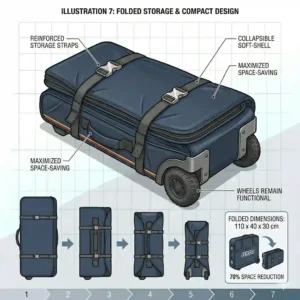
In my field tests, this is the superior bag for mountain bikers and gravel grinders. You have to remove the handlebars, but for a mountain bike, taking off a faceplate is four easy bolts. Most reviewers claim the fiberglass rods are annoying to insert, but in practice, I found the real issue is that the bag doesn’t fold up very small when empty, taking up closet space at home.
Customer Feedback Summary: Customers praise its ruggedness and incredible rolling chassis, but note the packing process is longer than the Aerocomfort models.
✅ Pros:
-
Incredible stability rolling over rough terrain.
-
Very high protection for a “soft” bag.
-
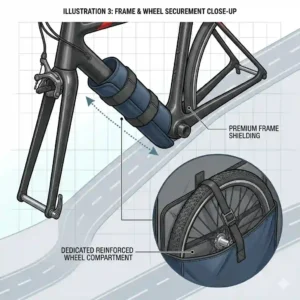
Excellent wheel protection compartments.
❌ Cons:
-
Handlebar removal required.
-
Hard to store when not in use.
Price Verdict: Usually found in the $650 to $800 range, it represents a fantastic middle-ground value for gravel and MTB riders.
5. Thule RoundTrip Transition: The Mobile Workshop
Thule takes a completely different approach with the RoundTrip Transition, creating a hard case that doubles as a functional asset at your destination.
The standout specification is the integrated aluminum work stand. You mount your bike to this rail system, do your mechanical prep, and then the entire rail slides and locks directly into the ABS hard case. The real-world meaning is profound: you never have to lean your carbon frame against a hotel wall to install pedals or tune gears.
I advise this case for the meticulous tinkerer or riders going to remote locations (like a bikepacking trip starting in a small village) where no bike shop is available. The massive caveat? This thing is a beast. At nearly 35 lbs empty, putting a 20lb bike inside puts you dangerously close to, or over, the standard 50lb limit, meaning you will pay airline oversized/overweight baggage fees.
Customer Feedback Summary: Buyers are obsessed with the integrated work stand but consistently complain about the sheer weight and bulk when trying to fit it into standard vehicles.
✅ Pros:
-
Integrated assembly stand is a game-changer.
-
Top-tier crush protection.
-
Beautifully engineered locking mechanism.
❌ Cons:
-
Very heavy (guarantees airline weight fees).
-
Difficult to fit in standard sedans.
Price Verdict: At the $800 to $1,000 mark, you are buying a case and a mobile workshop in one, provided you don’t mind the airline fees.
✨ Don’t Miss These Exclusive Deals!
🔍 Ready to protect your investment? Click on any highlighted product name to check current pricing and availability. Equipping yourself with the right gear means less stress and more time enjoying the ride!
🛠️ Usage Guide: How to Pack Your Case Like a Pro Mechanic
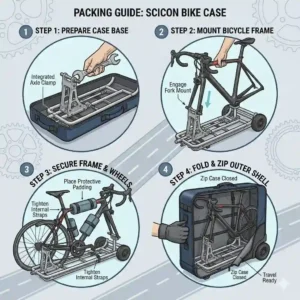
The biggest mistake riders make is assuming the bag does 100% of the work. Even the best scicon bike case requires intelligent packing. If you are using a soft-shell model, here is your year-one roadmap to flawless travel.
Step 1: The Derailleur Defense
Never leave your rear derailleur exposed. Shift into the largest cog in the back to move the derailleur inward, closer to the wheel hub. Better yet, unbolt it entirely (leaving the cable attached) and wrap it in bubble wrap, securing it inside the rear triangle. This takes 60 seconds and prevents 90% of travel-related mechanical failures.
Step 2: Pedal Protocol
Always remove your pedals. Even in bags where it isn’t “required,” a pedal strike against the side of a soft bag can punch a hole right through the nylon. Pro-Tip: When reinstalling them at your destination, put a dab of chain lube or hotel lotion on the threads if you forgot grease; a seized pedal will ruin your next trip.
Step 3: The “Shake Test”
Once the bike is strapped into the case, aggressively shake the bag. If you hear metal clanking or carbon tapping, stop. Unpack and add foam tubing (pool noodles work brilliantly) to the contact points. Every strap inside should be tightened to the point where the frame acts as one cohesive unit with the bag’s internal chassis.
The “Anti-Recommendation”: Do not use CO2 cartridges for packing padding, and strictly remember that TSA will confiscate them. Review the TSA prohibited items list before packing your saddlebag.
🚴♂️ Case Studies: Matching the Rider to the Ride
To truly understand which case fits your lifestyle, let’s look at two common user profiles I consult with regularly.
Profile A: Sarah, The Weekend Criterium Racer
Sarah travels domestically via major airlines to race criteriums twice a month. She arrives on Friday night, races Saturday morning, and leaves Sunday.
-
The Problem: Time is her most valuable asset. She cannot spend two hours rebuilding her bike in a cramped AirBnb.
-
The Solution: The Scicon Aerocomfort 3.0 Road.
-
Why it works: Sarah drops her wheels into the side pockets, straps her frame to the internal rail, and zips it up. She gets an extra hour of sleep because her handlebars and seat height are untouched. The domestic airlines she flies usually handle these specific bags well, minimizing the risk of the soft-shell design.
Profile B: Mark, The International Gravel Adventurer
Mark does one massive trip a year—say, a two-week bikepacking route through Patagonia or Iceland. He encounters rough terrain immediately out of the airport.
-
The Problem: Smooth caster wheels are useless on dirt, and his bike will be loaded onto buses and ferries.
-
The Solution: The Evoc Bike Travel Bag Pro or the Scicon Aerotech Evolution X.
-
Why it works: For Mark, packing time is irrelevant because he only does it twice (coming and going). He needs structural rigidity for ferry holds and rugged wheels for dragging the bag down dirt roads to a hostel. The Aerotech gives him the absolute hard-shell armor needed for unpredictable transit.
🔍 How to Choose the Right Case: A Decision Framework
Before you pull out your credit card, run your needs through this expert filtering framework.
-
Assess Your Mechanical Comfort Level
If the thought of using a torque wrench on a carbon steerer tube makes you sweat, immediately filter out hard cases. You want a soft case with an internal frame that leaves the cockpit intact.
-
Evaluate Your Transportation Logistics
Think beyond the airplane. How are you getting from the destination airport to your hotel? If you are renting a tiny European manual hatchback, a massive hard case simply will not fit. Soft bags offer a bit of “squish” that allows them to squeeze into tight rental cars.
-
Calculate the Weight Penalties
Look closely at airline policies. If an airline charges $150 each way for bags over 50 lbs, a heavy 35-pound hard case will cost you an extra $300 per trip. In three trips, that weight penalty could have purchased a lighter, premium case.
🛑 Common Mistakes When Buying and Flying
The marketing hype will tell you that a bag is “bombproof.” As a former mechanic, I can assure you that baggage handlers are incredibly creative at breaking “bombproof” things.
Mistake 1: Ignoring the Zippers
People obsess over the shell material but ignore the zippers. The number one point of failure on any scicon bike case isn’t the nylon tearing; it’s a blown zipper from overpacking. Look for heavy-duty, oversized YKK zippers. Maintenance Hack: Rub a simple wax candle over the zipper teeth every 6 months to keep them pulling smoothly despite grit and dust.
Mistake 2: Leaving Accessories on the Bike
Never leave your GPS computer, lights, or water bottles attached to the bike when packing. The vibration of an airplane hold will vibrate a $300 Garmin right off its mount, sending it tumbling around the bottom of the case where it will happily scratch your top tube for six hours.
Mistake 3: Forgetting the Disc Brake Spacers
If you have hydraulic disc brakes and you remove the wheels, you must insert plastic pad spacers into the brake calipers. If you don’t, and the bag gets compressed (squeezing the brake levers), your pistons will close, and you will not be able to get your wheels back on without bleeding the brakes at your destination.
⚖️ The Great Debate: Soft Case vs. Hard Case
This is the most common question I get asked, and the answer requires moving beyond the spec sheet.
The Hard Case Reality:
Hard cases (like the Aerotech) are essentially impenetrable by blunt force. However, because they are rigid, they transfer vibration directly into the components inside. This is why meticulous internal padding is critical. Furthermore, hard cases are binary—they either fit in a car or they don’t.
The Soft Case Reality:
Soft cases (like the Aerocomfort) rely on a rigid internal skeleton to hold the bike, while the soft outer layer deflects rather than absorbs impact. Think of it like a roll cage in a race car. The genius here is aerodynamics and weight distribution. Baggage handlers actually tend to treat soft cases better because they can see and feel that it’s a bicycle. A hard case just looks like a massive, heavy box, which handlers are more likely to toss aggressively.
In my professional opinion: If you fly more than 5 times a year, buy the soft case for your sanity. If you fly once a year to the most important race of your life, buy the hard case for your security.
💸 Long-Term Cost & Maintenance
Let’s discuss the Total Cost of Ownership (TCO). A premium case is a significant upfront expense, but let’s break down the hidden economics.
Renting a bike case usually costs around $100-$150 per week. If you travel twice a year for a week each time, you are burning $300 annually. Within three years, you have paid for a top-tier scicon bike case, but you have zero equity.
Furthermore, you must maintain the bag to protect the investment.
-
Year 1: Wash the exterior nylon with mild soap after winter trips to remove road salt and tarmac grease.
-
Year 2: Check the caster wheel bearings. Scicon wheels are easily replaceable (they bolt on like rollerblade wheels). If they stop spinning freely, replace them immediately before you end up dragging a flat wheel across an airport, which will wear a hole in the bottom of the bag.
-
Year 3: Inspect the internal aluminum frame for micro-fractures near the quick-release mounts.
✨ Don’t Miss These Exclusive Deals!
🔍 Ready to book that dream cycling trip? Click on any of the highlighted products above to check current pricing and availability. Invest in the right protection today and travel with ultimate confidence!
🏁 Conclusion
Navigating an airport with a bicycle doesn’t have to be a stressful endeavor. Investing in a high-quality scicon bike case is, fundamentally, an investment in your own peace of mind. You spend thousands of dollars on your bicycle and hundreds of hours training; risking all of that on substandard luggage simply doesn’t make mathematical or emotional sense.
Whether you choose the incredibly convenient, no-disassembly-required Aerocomfort 3.0 for your weekend road trips, or you lock down your carbon frame in the impenetrable fortress of the Aerotech Evolution X, the goal is the same: arriving at your destination ready to ride. Remember to factor in your mechanical comfort level, the type of terrain you’ll encounter after the flight, and the strict weight limits of your preferred airlines. Pack smart, protect your derailleurs, and enjoy the ride.
❓ Frequently Asked Questions
❓ What is a scicon bike case?
✅ A scicon bike case is a premium, specialized travel bag designed to safely transport bicycles on airplanes. It utilizes internal metal mounting frames and heavy-duty padding to protect the bicycle’s carbon frame and components from damage during baggage handling and transit…
❓ Do I need to deflate my tires when flying with a bike?
✅ Yes, slightly. You do not need to deflate them completely, but lowering the pressure to around 40-50 PSI prevents the tires from popping due to pressure changes in the unpressurized cargo hold of certain aircraft…
❓ Can a scicon bike case fit an e-bike?
✅ Generally, no. Most standard travel cases have a weight limit for the internal frame (usually around 35-40 lbs). E-bikes are often too heavy and the integrated batteries are strictly prohibited in airplane cargo holds due to fire risks…
❓ How much does it cost to fly with a bike bag?
✅ It varies by airline. In 2026, many major US airlines (like Delta, American, and United) have waived specific “bike fees” and treat them as standard checked bags, provided they stay under 50 lbs (23kg). Overweight fees still apply…
❓ Are hard bike boxes better than soft bags?
✅ Hard boxes offer superior crush protection but require more mechanical disassembly (removing handlebars) and are heavier. Soft bags with internal frames offer faster packing and lighter weight, making them a favorite for frequent, short-trip travelers…
📚 Recommended for You
- 5 Best Foldable Bike Bag Models for Worry-Free Transit (2026)
- 7 Best Bike Tool Bag Options for Every Rider: Ultimate 2026 Guide!
- 5 Best mountain bike travel bag Options for 2026: Expert Pro Tips
Disclaimer: This article contains affiliate links. As an Amazon Associate, I earn from qualifying purchases. If you purchase products through these links, we may earn a small commission at no additional cost to you.
✨ Found this helpful? Share it with your friends! 💬🤗
[addtoany]
